Prop Firm Trading Without Time Limits: What It Really Means for Your Challenge Strategy

A 30-day evaluation window sounds manageable until the clock hits day 22 and you are still 3% away from your profit target. At that point, most traders stop following their plan. They over-leverage. They chase setups that do not meet their own criteria. They do the exact same thing the evaluation is supposed to prove they will never do.
Research on deadline-driven decision making shows consistent patterns: as deadlines approach, people take increasingly larger risks to meet targets, and in trading, this manifests as behaviors that increase drawdown risk, which is ironically the exact failure mode the prop firm is testing you on. A time limit creates the psychological conditions that make you more likely to fail via the mechanism you are supposed to be avoiding.
The prop trading industry has, in the past few years, shifted toward no-time-limit evaluations. This trading model helps address the primary cause of trader failure: the psychological pressure of artificial deadlines. By removing the 30-day race to the finish, these prop firms allow traders to wait for high-probability setups, significantly increasing the probability of long-term funding.
This article explains what prop firm trading without time limits actually means, how it changes your approach to risk and strategy, and why traders who choose the right structure consistently perform better than those racing a countdown.

Key Takeaways
- Time pressure distorts risk-taking: A Journal of Risk and Uncertainty study found that time pressure increases risk-taking for losses compared to time delay, meaning that a deadline structurally pushes traders toward bigger, riskier decisions at exactly the wrong moment.
- No-time-limit evaluations align with how professionals actually trade: Less psychological pressure means you can wait for quality setups instead of forcing trades. It mimics how professional traders operate: patience over speed. Therefore, if your goal is to develop real trading habits, the no-time-limit structure is the more realistic environment.
- Most trading styles benefit, but swing traders benefit the most: When picking a proprietary trading firm with no time limits, focus on identifying one that suits your trading style and pace. For traders who work with long-term trends or swing strategies, the ability to trade without the stress of meeting deadlines can be a game-changer.
- The rule structure still matters: Removing time limits does not remove all constraints. Five rules decide almost every evaluation: profit target (typically 5-10%), maximum drawdown (5-10%), daily loss limit (3-5%), minimum trading days (commonly 0 to 4, with some firms reaching 40) and banned strategy clauses. Choose a firm whose remaining rules also fit your strategy.
- OneStopProp’s model is built around this philosophy: OneStopProp enforces no time limits and states that good trading often requires patience. The firm also allows overnight and weekend holding, letting traders maintain positions based on strategy and market conditions rather than arbitrary time restrictions.
Quick-Start Prioritization Framework
| Strategy Type | Is No Time Limit Critical? | Effort to Adapt | Biggest Risk Without It |
|---|---|---|---|
| Swing trading (multi-day holds) | High | Low, trade naturally | Forced premature exits |
| Position trading (trend following) | High | Low | Strategy becomes impossible |
| Day trading (intraday only) | Medium | Low | Overtrading near deadline |
| Scalping (many trades, small targets) | Low | None | Minimal impact |
| Algorithmic / EA trading | Medium | Low, bots run on schedule | Strategy disrupted by external clock |
| Part-time trading | High | Low | Missed sessions create deadline panic |
Start here if you are:
- A swing or position trader: A no-time-limit firm is non-negotiable. If your strategy requires holding trades for hours, days, or weeks, the wrong prop firm will fight your style at every turn. The right firm gives you room to let trades develop. The wrong firm penalizes you for doing exactly what your strategy demands.
- A part-time trader: Missed market sessions eat into a countdown window. A no-deadline account means a busy week at work does not compromise your evaluation.
- A day trader who overtraded during a previous timed challenge: The deadline was likely the trigger. Remove it, and your natural discipline returns.
Why Time Limits Harm Trading Decisions
The Psychology of Deadline Pressure
Research published in the International Journal of Environmental Research and Public Health confirms that people tend to make more risky choices when under high time pressure, with neurological markers of outcome evaluation diminished under these conditions. In trading terms, this is the shift from calculated risk to reactive gambling.
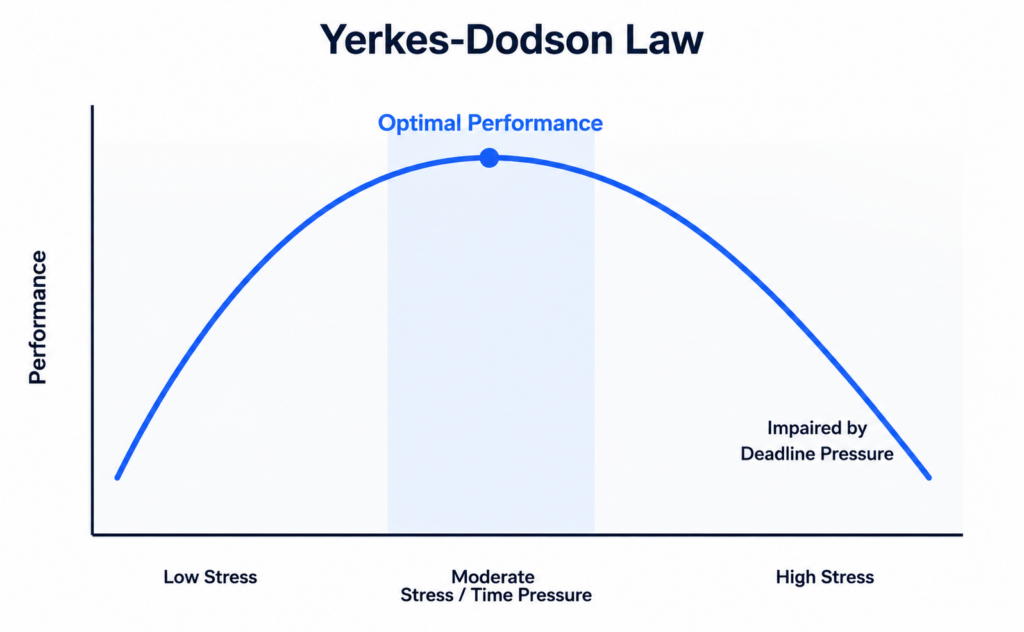
The Yerkes-Dodson Law describes the relationship between stress and performance: moderate stress can enhance performance, but too much impairs it. Under extreme time pressure, the decision-making process becomes streamlined but potentially flawed, where the luxury of deliberation is traded for the currency of immediacy. A prop evaluation with a hard deadline pushes traders past moderate stress and into impaired territory.
Pro Tip: If you review a losing challenge account and notice that most of your outsized losses happened in the final 10 days, deadline pressure is the likely cause. The fix is the environment, not just the strategy.
Forced Trades vs. Quality Setups
Without a countdown hanging over every trade, you can focus on execution rather than rushing to meet a deadline. Many traders increase risk as evaluation deadlines approach, and removing the deadline makes it easier to stick to your trading plan.
Professional traders do not force trades because of time. Challenges without time limits better reflect real-world trading conditions. This matters because prop firms exist to find traders who can manage capital the way professionals do. Evaluations that trigger un-professional behavior are self-defeating for both sides.
In my experience, the clearest sign that a trader is operating under too much time pressure is an expanding average trade duration. When the clock ticks down, traders who normally hold for hours start cutting winners early and letting losers run, exactly the opposite of what works.
What “No Time Limit” Actually Means (and What It Does Not)
The Core Definition
A no-time-limit prop firm challenge simply means there is no deadline for hitting your profit target. You can take 20 days or 90 days, as long as you stay within the drawdown rules, the account stays live. This is distinct from “no minimum trading days,” which is a separate feature where some firms require you to trade at least a set number of days to prove activity.
Understanding this distinction is practical, not academic. When picking a proprietary trading who prefer taking their time to meet evaluation criteria, whereas “no minimum trading days” suits those who can achieve targets swiftly and prefer not to be bound by a set number of trading days. Both features together give you maximum flexibility; only one of them removes the deadline pressure.
Minimum Trading Day Requirements
At OneStopProp, the 3-day minimum on challenges and the 8-day minimum for funded account payouts are not time limits. They represent the minimum required number of trading days to advance to the next phase or request a payout. This is a meaningful difference. A minimum trading day requirement proves you are an active participant. A time limit forces you to reach a financial target by a specific date regardless of market conditions. Only the latter is damaging to sound decision-making.
What Still Applies
Removing the time limit does not remove all structure. Prop firm rules including daily loss limits and trailing drawdowns define the boundaries every trade must stay within. Understanding how a platform tracks gains and losses in real time determines how long a trader stays funded.
Pro Tip: Read the payout and funded account terms before the challenge rules. The challenge rules tell you how to pass. The payout terms tell you whether passing is actually worth anything. This is where many traders discover that a seemingly flexible firm still has restrictive conditions on the funded side.
How No-Time-Limit Trading Changes Your Strategy
Swing and Position Traders
Unlike day trading or scalping, swing trading relies on keeping positions open for several days, sometimes weeks. Classic swing setups aim for 100 to 500 pip captures in forex, or significant moves in indices and commodities. A 30-day evaluation window makes this strategy functionally impossible: by the time a position has developed its full thesis, the evaluation may already be closed.
Swing trading allows traders to hold positions for longer periods compared to day trading, offering more flexibility and reducing the need for constant monitoring. It is generally less stressful since it does not demand real-time decision-making. By holding positions for a few days to weeks, swing traders have the potential to capture larger price moves than day traders.
Day Traders and Scalpers
Even traders who do not technically need extended holding periods benefit from the removal of deadline pressure. Trading under pressure is tough. Emotions like fear, greed, and overconfidence can derail even the best strategies. Emotional triggers, FOMO, revenge trading, overconfidence, and performance anxiety, can lead to poor choices.
For scalpers, the risk is overtrading. A timed challenge creates a quiet but constant incentive to open additional positions on days when the strategy says to stay out. Remove the clock and that incentive disappears.
Part-Time Traders
Flexibility allows traders to coordinate their trading with personal commitments, enabling a better work-life balance. Additionally, having ample time to research market trends enables traders to make more informed and profitable decisions.
I’ve found that part-time traders are among the most disciplined participants in no-time-limit evaluations. They trade selectively by necessity, and a structure without deadlines rewards exactly that selectivity.
Risk Management Inside a No-Deadline Structure
Why Drawdown Rules Become More Important
Without an external time pressure pushing you to act, the primary remaining constraint is drawdown. Prop firm rules are not designed to block profit. They are designed to block uncontrolled risk. Most traders fail evaluations for the same reason they blow personal accounts: they treat drawdown limits as flexible, they oversize during stress, they revenge trade after a loss, or they stack exposure across correlated trades.
Establishing a daily loss limit of 1% to 2% keeps trading decisions separate from the emotional impulse to recover losses immediately. If you cannot breach a deadline, your biggest remaining risk is a drawdown breach, so position sizing becomes your most important daily discipline.
The Consistency Advantage
Consistency rules exist because prop firms are looking for traders who can generate repeatable, sustainable profits, not traders who got lucky on one big trade. A trader who makes $10,000 in one day and nothing the rest of the month is unpredictable. A trader who makes $500 per day for 20 days is bankable.

Pro Tip: In a no-time-limit, no-consistency-rule account, the single most important habit you can build is a written pre-session plan. Use the time before markets open to review your trading plan, check economic calendars, and prepare your watchlist. A structured routine helps you avoid making impulsive decisions. Without a clock forcing you to act, the discipline has to come from structure you create yourself.
Choosing the Right No-Time-Limit Prop Firm
What to Evaluate Beyond the Time Rule
Risk management rules vary meaningfully across prop firms, particularly around drawdown type, daily loss limits, and consistency requirements. Before committing to any firm, make sure you understand not just the numbers but the mechanics behind them.
Key factors to compare:
- Whether overnight and weekend holding is permitted
- Static versus trailing drawdown calculation (trailing drawdown can breach an account on unrealized gains)
- Payout frequency and minimum withdrawal amounts
- Whether the consistency rule applies to the funded account as well as the evaluation
OneStopProp’s Model in Practice
The modern market environment is diverse, and trading options should match that diversity. OneStopProp supports forex, stocks, indices, commodities, and cryptocurrencies, all tradable from a single account, a rarity in the prop firm world.
According to one funded trader’s review, OneStopProp stood out by offering stocks, forex, and crypto trading all in one account with 100% profit splits for the 5 first payouts, clear and simple rules without mandatory trading days, and overnight holding, alongside a reasonable 5% profit target for phase 2. Per OneStopProp’s payout guidelines, traders can request a payout every 14 days, with a daily payout option available as an add-on for those who want more frequent withdrawals.
For traders who want more from their funded account, OneStopProp’s Pro Accounts offer an upgraded tier designed for those seeking higher capital and expanded features, worth exploring at onestopprop.com/checkout/.
Common Mistakes Even Good Traders Make Without a Time Limit
Treating Patience as Inactivity
Removing the clock does not mean sitting on your hands indefinitely. Some firms close inactive accounts after 30 to 60 days. Others keep them open indefinitely. It is worth checking the firm’s inactivity policy before purchasing. A no-time-limit structure rewards patient selectivity, not prolonged absence from the market.
Drifting Strategy Mid-Evaluation
In my experience, the absence of deadline pressure sometimes creates a different problem: traders start experimenting. Without the urgency of a countdown, some begin testing new approaches mid-evaluation, mixing their proven system with ideas that have not been validated. The evaluation environment should be used to demonstrate your edge, not to develop new ones.
Misreading Drawdown Mechanics
Misunderstanding trailing drawdown mechanics is one of the most frequent reasons traders lose funded accounts right after a strong week. Assuming the floor is fixed when it is actually trailing catches traders off guard. This mistake happens more often in no-time-limit evaluations because traders relax after early gains, not realizing that a trailing drawdown has raised the floor they need to stay above.
Frequently Asked Questions
What does “no time limit” mean in a prop firm challenge?
No time limit in a prop trading challenge allows traders to complete evaluation phases at their own pace. Unlike typical prop firms that impose 30-day or 60-day completion windows, no time limit challenges remove deadlines entirely. You still need to meet the profit target and stay within drawdown rules, the only thing removed is the hard date by which you must do so.
Does trading without time limits make it easier to get funded?
It removes one significant source of behavioral error, but it does not make the profit target or drawdown rules easier. Beginners often need more time to develop consistency and learn the evaluation rules. A no-time-limit evaluation lets you trade small, learn the platform, and build confidence without the pressure of a ticking clock. The structural advantage is real, but you still need a working strategy.
Which trading styles benefit most from no-time-limit evaluations?
Swing traders and position traders benefit the most because their strategies require multi-day or multi-week holding periods that simply cannot fit inside a standard 30-day window. Swing trading offers lower stress, longer cycles, steady development, and more flexibility, all of which align naturally with a no-deadline evaluation structure. Day traders and scalpers benefit less directly, but still gain from the removal of deadline-driven psychological pressure.
Can I hold positions overnight and over the weekend in a no-time-limit account?
This depends on the specific firm and account type. Most prop firms are day-trading only. A swing-capable firm gives you the flexibility to trade multi-day setups, hold through an overnight catalyst, or carry a position over a weekend, all on the firm’s capital. Always confirm overnight and weekend hold permissions before purchasing, as not all no-time-limit firms allow both. OneStopProp explicitly permits overnight and weekend holding across its accounts.
How do payouts work if there is no time limit on completing the evaluation?
The evaluation timeline and the payout schedule are separate systems. Once you are funded, payout rules apply on their own terms. OneStopProp strives to make the payout process straightforward and transparent, with clear rules and guidelines around requesting payouts. Most funded traders request payouts on a bi-weekly cycle, with a daily payout add-on available for those with more active withdrawal needs.
Ready to trade at your own pace? Explore OneStopProp’s funded account options and find the structure that fits the way you actually trade.
Sources
- Top Prop Firms with No Time Limits, TopOneTrader. Comparison of leading no-time-limit evaluation structures. https://www.toponetrader.com/blog/top-5-prop-firms-with-no-time-limits
- Prop Firms With No Time Limit in 2026: Why It Matters More Than You Think, Best Funded. Analysis of how time limits change trading behavior. https://best-funded.com/prop-firm-no-time-limit-2025/
- What Does “No Time Limit” Mean in Prop Firm Challenges?, FundedNext. Definition and benefits of no-deadline evaluations. https://fundednext.com/blog/no-time-limit-prop-firm-trading-challenges
- Best Prop Firms With No Time Limit, Traders Union. Comparison guide with strategic guidance. https://www.benzinga.com/money/best-no-time-limit-prop-firms
- Best Prop Firms with No Time Limits (2026), Audacity Capital. Industry shift toward no-deadline models. https://audacity.capital/trading-guides/prop-firms-with-no-time-limits/
- The Effect of Fast and Slow Decisions on Risk Taking, Journal of Risk and Uncertainty / Springer Nature. Peer-reviewed research on time pressure and financial risk. https://link.springer.com/article/10.1007/s11166-017-9252-4
- Time Pressure Affects the Risk Preference and Outcome Evaluation, International Journal of Environmental Research and Public Health. Neurological and behavioral study of high time pressure decisions. https://www.ncbi.nlm.nih.gov/pmc/articles/PMC9963851/
- How Does Time Pressure Influence Risk Preferences? Answers from a Meta-Analysis, Journal of Consumer Research / Oxford Academic. Meta-analysis of 83 papers covering 65,574 subjects. https://findanexpert.unimelb.edu.au/scholarlywork/1824589-how-does-time-pressure-influence-risk-preferences%3F-answers-from-a-meta-analysis
- Why Traders Are Moving Away from Traditional Prop Firms, OneStopProp. Official description of the firm’s no-time-limit, no-consistency-rule model. https://checkout.onestopprop.com/why-traders-are-moving-away-from-traditional-prop-firms-the-onestopprop-difference/
- Payout Information and Guidelines, OneStopProp. Official payout rules, frequency, and minimum withdrawal details. https://checkout.onestopprop.com/payout/
- Effective Risk Management Strategies for Prop Firm Funded Accounts, Apex Trader Funding. Practical breakdown of daily loss limits and trailing drawdown mechanics. https://www.passproptradingfirms.com/rules/
- Risk Management Rules in Funded Accounts in 2026, PropFirmShop. Common mistakes traders make with drawdown and consistency rules. https://propfirmshop.com/blog/risk-management-rules-in-funded-accounts/
- Prop Firm Consistency Rules Explained, PropFirmMap. How consistency rules work and which firms enforce them. https://propfirmmap.com/blog/prop-firm-consistency-rules-explained-strategies-pass-2026
- Prop Firm Rules That Surprise New Traders, ThePropFirmGuide. Overview of complex evaluation rules and compliance pitfalls. https://thepropfirmguide.com/prop-firm-rules/
- Swing Trading vs Day Trading: Which is Better for Prop Traders?, AtmosFunded. Comparison of trading styles inside prop firm evaluation structures. https://atmosfunded.com/swing-trading-vs-day-trading/
- Psychology Tips for Trading Under Pressure, ForTraders. Behavioral strategies for managing emotional triggers in live trading. https://www.fortraders.com/blog/psychology-tips-for-trading-under-pressure
- OneStopProp Checkout, OneStopProp. Account options, sizing, and minimum trading day details. https://checkout.onestopprop.com/checkout/