7 Reasons Multi-Asset Traders Should Ditch Single-Market Prop Firms

If you trade forex, stocks, and crypto, you already know the feeling: you have a clear setup on a tech stock, but your prop firm only funds currency pairs. You sit on the sidelines watching the move happen without you. That experience is avoidable, and it points to a structural problem with single-market prop firms that most traders accept far too easily.
Search interest in the prop trading sector grew 607% between 2020 and 2024, and the industry is now estimated to be worth $20 billion globally, with over 2,000 active firms, which means you have real choices. The question is whether you are making the right one. This article explains exactly why multi-asset prop firm trading beats the single-market alternative, and what to look for when you switch.

Key Takeaways
- Single-market firms cap your opportunity set: In 2026, a growing number of firms claim to cover everything, but the quality of multi-asset coverage varies enormously between firms, real multi-asset prop trading means forex, stocks, indices, commodities, and crypto on one account, under one evaluation, with consistent rules across all asset classes.
- Markets rotate, and idle capital kills returns: Gold, silver, and Nasdaq volatility are creating new trading opportunities in 2026, and more crypto traders are adding traditional assets to their watchlists during crypto consolidation. If your firm locks you into one market, you cannot follow those moves.
- The prop industry is consolidating around multi-asset: MetaTrader’s market share fell from 48% to 24% after 2024 restrictions, pushing firms to adopt multi-asset platforms. Firms that did not adapt lost traders.
- OneStopProp is the standout choice for multi-asset traders: OneStopProp lets you trade forex, stocks, indices, commodities, and cryptocurrencies all from a single account, a rarity in the prop firm world.
- Funding levels matter: OneStopProp combines stocks forex, and crypto trading with overnight holds, no consistency rules, fast payouts, and up to $1.2M in funding available. That is the infrastructure a serious multi-asset trader needs.
Quick-Start Prioritization Framework
| Strategy | Best For | Effort Level | Time to Results |
|---|---|---|---|
| Switch to a multi-asset firm immediately | Any trader losing setups due to asset restrictions | Low | Days |
| Master 2-3 correlated asset pairs (e.g., gold + USD pairs) | Forex traders expanding into commodities | Medium | 2-4 weeks |
| Build a rotation system across markets | Experienced traders with 6+ months funded history | Medium-High | 1-3 months |
| Add a Pro Account tier with larger capital | Profitable funded traders ready to scale | Low (application) | 1-2 weeks |
| Run simultaneous accounts across asset classes | Advanced traders managing multiple strategies | High | Ongoing |
Start here if you’re:
- New to multi-asset prop trading: Switch firms first, then learn one new asset class alongside your primary market. Fastest path to keeping your edge while expanding.
- Already funded at a single-market firm: Open a multi-asset account in parallel before fully committing. Compare the rule sets and verify payout speed.
- Profitable but hitting a ceiling: Access up to $300,000 in trading capital on a funded account at OneStopProp, and consider their Pro Accounts to scale further as your performance compounds.
Reason 1: Single-Market Firms Force You to Miss the Best Setups
Markets Move in Turns, Your Firm Shouldn’t Stop You Following Them
In 2026, experienced traders focus on balance rather than prediction. They combine crypto’s growth potential with gold’s stability to navigate market cycles. Many traders rotate profits from strong crypto moves into gold positions to lock in gains and reduce overall risk. A forex-only firm makes that rotation impossible on a funded account.
While crypto’s largest assets stalled after late-2025 highs, capital kept rotating into precious metals. That gap created an unusual situation for crypto traders. The most active and volatile markets in 2026 were no longer native crypto assets; they were gold and silver. A trader locked into a single-market firm would have watched that entire trend from the sidelines. If you are consistently missing high-probability setups because your firm restricts your markets, that is not a discipline problem, that is a firm problem.
Pro Tip: Before you pay any evaluation fee, check the firm’s full instrument list. Look specifically for at least 3 asset classes with no session restrictions. If the instrument list has asterisks, fees, or “limited availability” disclaimers, those are red flags.
What the Data Says About Multi-Asset Opportunity Costs
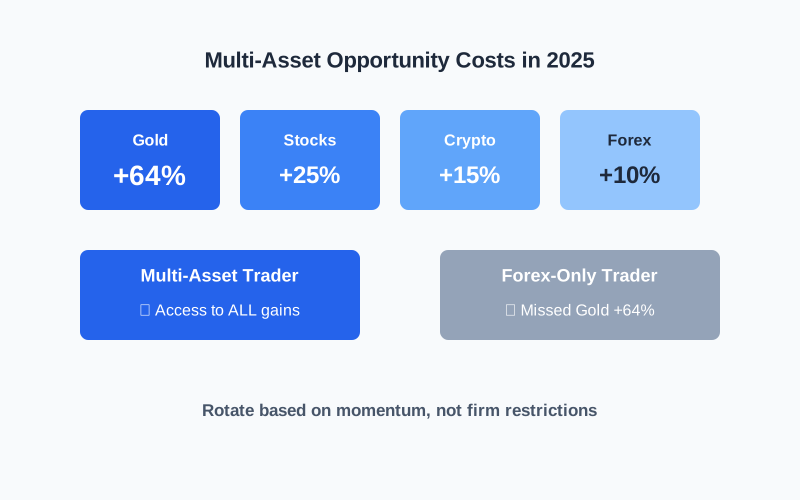
All major asset classes posted gains in 2025, with gold leading as the top performer with approximately 64% returns. A trader funded only on forex would have zero access to that run. Rotate your lens based on where momentum lives, not on what your firm happens to allow.
Reason 2: Cross-Market Correlations Are a Real Edge, and Single-Market Firms Block Them
Correlation Trades Require Access to Both Sides

The most profitable market setups often involve relationships between assets. Gold moves inversely to a strengthening dollar. Tech stocks and crypto tend to move together during risk-on environments. Gold’s correlation with stocks is typically low and often becomes inversely correlated during periods of stress, providing portfolio diversification. In fact, gold can rally due to the same factors that would result in a stock market drop. For instance, economic uncertainty and high inflation can attract investors to gold, sending its price up.
If you only have access to one market, you cannot trade the relationship between markets. You are reading half a sentence. OneStopProp lets traders capitalize on relationships between markets that most prop traders cannot access due to platform limitations. This multi-asset approach gives OneStopProp traders a significant edge; they can follow opportunities wherever they appear rather than being confined to a single market.
The Practical Setup a Multi-Asset Trader Uses
Serious multi-asset traders monitor BTC and ETH with ETF flow data and on-chain metrics on one side, and gold and Nasdaq with real rates, the earnings calendar, and the dollar index on the other. When something is moving, they have a position. That workflow requires a prop firm that funds all of those instruments. Anything less is a structural handicap.
Reason 3: Single-Market Firms Are Increasingly Fragile
The Industry Consolidation Problem
The prop trading industry has grown rapidly, but so has its rate of failure. In 2024, only 71 out of 82 prop firms tracked by Brokeree Solutions remained operational by Q4, a shutdown rate of about 1 in 7. Finance Magnates Intelligence estimates between 80 and 100 firms may have disappeared from the market that year alone. Firms that focused on a single asset class, particularly those built entirely around forex CFDs, were disproportionately represented in that collapse.
In 2025, firms faced severe pressure. FundingTicks, for instance, introduced retroactive rule changes that invalidated profits before shutting down in January 2026. This is the specific risk of over-reliance on a narrow, regulated-away revenue model. If you are with a firm whose entire business rests on one asset class, its regulatory or liquidity risk becomes your risk. If your firm’s core market faces regulatory pressure, your funded account is collateral damage. Choose a firm whose business model spans multiple asset classes and revenue streams.
Reason 4: You Are Paying for a Skill Set, Use All of It
The Evaluation Is an Obstacle, Not a Career Path
A prop firm provides traders with capital to trade financial markets. Instead of risking your own money, you trade the firm’s capital and keep the majority of the profits, typically between 70% and 90%. The idea is simple: the firm provides the money and the trader provides the skill. If your skill set spans multiple markets, which it does, if you have been trading for any length of time; you should not be bottlenecked into proving it in only one.
In my experience, traders who come from a multi-asset background consistently feel constrained at single-market firms. They spend evaluation periods forcing trades in one market just to hit targets, when their best opportunities were sitting in a completely different instrument.
Trading across multiple asset classes including digital assets, forex, and indices allows traders to engage in scalping and capture opportunities across different markets from a single account. That flexibility compounds across a full trading career. At a single-market firm, the compounding stops at the market boundary.
Reason 5: Drawdown Rules Hit Differently Across Asset Classes
Volatility Profiles Vary, Your Firm’s Rules Should Account for That
True multi-asset prop trading means one evaluation, one funded account, and consistent rules across all asset classes, not selective access with heavy restrictions. Static drawdown is significantly more compatible with multi-asset strategies than trailing drawdown, which creates asymmetric risk across different asset volatility profiles.
I’ve found that this point gets overlooked more than almost any other. A trailing drawdown that works reasonably well on a forex pair can destroy a position in a more volatile crypto or commodity instrument. Single-market firms typically design their risk parameters around one asset’s volatility. When they expand their instrument list without updating those parameters, they create a hidden trap for multi-asset traders.
Most failed evaluations come from breaching a measurement mechanic, equity vs balance, trailing vs static drawdown, server-time resets, rather than from a genuinely bad trade. Five rules decide almost every evaluation: profit target, maximum drawdown, daily loss limit, minimum trading days, and banned strategy clauses. Understand which of those rules were designed with your asset class in mind, and which were bolted on as an afterthought.

Reason 6: Prop Firm Rule Changes Hit Single-Market Traders Hardest
Regulatory Pressure Concentrates in Single Markets
Several firms now operate in a grey zone or have explicitly geo-blocked sign-ups following regulatory pressure that accelerated through 2024 and 2025. The CFTC and NFA have spent the last 2 years tightening their position on offshore simulated trading programs that pay out on forex performance. This regulatory pressure is almost entirely concentrated on forex-only and CFD-only business models.
What started as a largely unregulated space offering traders access to capital with minimal oversight is now under intense audit from the CFTC, FCA, ASIC, and other global regulators. If you are trading with a prop firm or planning to get funded in 2026, you need to understand what is changing. The firms navigating that audit most successfully are those with diversified asset class offerings and diversified revenue models.
Pro Tip: When evaluating any prop firm, read the full Terms and Conditions, specifically the clause allowing the firm to modify rules. Prop firm Terms and Conditions typically include provisions allowing the firm to modify rules, sometimes with notice and sometimes without. The FundingTicks case is the most recent documented example: December 2025 rule changes were applied to existing accounts and completed evaluation stages, resulting in profit clawbacks.
Reason 7: Multi-Asset Prop Firms Offer Better Long-Term Scaling
OneStopProp: Editor’s Pick, Best Overall for Multi-Asset Traders
When you are ready to scale, the ceiling matters as much as the floor. OneStopProp stands out because they offer stock trading, which is uncommon with most prop firms. Being able to trade stocks alongside other assets gives traders more flexibility and opportunities in the market.
Here is what the firm delivers for traders who want to grow across markets:
Pros:
- Ability to trade: forex, stocks indices, commodities, and cryptocurrencies all from a single account
- Up to 90% profit split with no hidden fees and no activation fees
- Overnight holds, no consistency rules, and fast payouts
- Clear and simple challenge rules without mandatory trading days, with overnight holding permitted and reasonable profit targets
- Up to $1.2M in total funding available with Pro Accounts for high-performing traders
Cons:
- Primarily suited to active discretionary traders, systematic or HFT strategies should verify their specific eligibility
Why the Pro Accounts Matter for Serious Multi-Asset Traders
If you are generating consistent returns across markets, scaling capital is the next logical step. OneStopProp’s Pro Accounts are designed specifically for that growth phase. I’ve found that traders who jump between firms chasing the highest advertised split often leave money on the table by forfeiting scaling benefits they had already earned. Staying within a firm whose asset breadth matches your strategy, and growing the account size there, compounds faster than account-hopping. If you’re ready to take that step, explore OneStopProp’s funded account options and see whether the Pro Account tier fits your current performance profile.
How to Choose the Right Multi-Asset Prop Firm: A Short Decision Guide
Not every firm that claims multi-asset coverage delivers it consistently. For traders who want real flexibility, the differences matter. The best multi-asset prop firm in 2026 is the one whose rules stay consistent across every asset class. Use these 3 filters:
- Instrument breadth: Does the firm fund at least forex, stocks, and crypto with no asterisks or “limited” qualifiers?
- Rule consistency: Are drawdown rules the same across all instruments, or does the firm apply different parameters to “riskier” assets?
- Payout structure: Payout speed and split percentage are the two numbers that matter most when evaluating a prop firm. In 2026, the industry has moved significantly toward faster payouts, daily and on-demand options are now available at some firms.
Frequently Asked Questions
What is multi-asset prop firm trading?
Multi-asset prop firm trading means being funded to trade across more than one asset class, typically forex, stocks, crypto, indices, and commodities, from a single evaluation and funded account. The defining feature is consistent rules across all asset classes, not selective access where one market is essentially restricted once you dig into the fine print. The key advantage over single-market firms is that you follow opportunities wherever they exist rather than being confined to one market.
Why do most prop firms only support one market?
Most prop firms started as forex firms, and a handful started as crypto firms. In 2026, a growing number claim to cover everything, but the quality of multi-asset coverage varies enormously between firms. The operational complexity of supporting multiple asset classes, different liquidity providers, different volatility profiles, different regulatory requirements, is the reason most firms stick to one lane. Firms that have genuinely built multi-asset infrastructure deserve the premium they command.
Is multi-asset trading harder to manage within prop firm rules?
It requires more attention to instrument-specific volatility, but the risk management principles are the same. Multiple studies show that traders who risk under 2% per trade are significantly more likely to pass challenges and stay funded, and that rule applies equally whether you are trading EURUSD or NVDA. The main adjustment is understanding how each firm’s drawdown mechanic interacts with the volatility of your chosen instruments.
How much capital can I access at a multi-asset prop firm?
It varies by firm and account tier. OneStopProp offers up to $1.2M in funding available across their account tiers, including standard and Pro Account options for traders who have demonstrated consistent performance. The industry as a whole has scaled up considerably, global payouts in 2025 exceeded $325 million, reflecting the volume of capital being deployed to funded traders worldwide.
Can I trade overnight positions and news events at a multi-asset firm?
Rules vary significantly by firm. Most restrict overnight holds entirely, and news trading bans are even more common.
At OneStopProp, overnight and weekend holds are allowed on all accounts. News trading depends on account type. Standard accounts require closing all positions 5 minutes before major events like FOMC, CPI, NFP, and individual stock earnings reports. Pro accounts have no news restrictions at all, you can hold through earnings, FOMC, and CPI without closing.
Always verify these terms before paying any evaluation fee. Overnight and news restrictions are among the most common sources of unexpected account violations across the industry.
If your strategy involves news events or multi-day holds, OneStopProp gives you both: overnight access on every account, and full news trading freedom on the Pro account.
Ready to trade every market your strategy demands? Get funded at OneStopProp and access stocks, forex, and crypto on a single account with no hidden restrictions.
Sources
- Prop Firm Industry Statistics 2026, Atmosfunded. Industry data on prop firm market size and search interest. https://atmosfunded.com/prop-firm-statistics/
- Best Multi-Asset Prop Firm 2026, Velotrade. Comparative analysis of multi-asset prop firm coverage and rule consistency. https://velotrade.com/blog/best-multi-asset-prop-firm
- The Future of Prop Firms: Where the Industry Is Headed, For Traders. Platform market share data and industry trends. https://www.fortraders.com/blog/future-prop-firms-industry-headed
- Why Traders Are Moving Away from Traditional Prop Firms, OneStopProp. Multi-asset offering and market correlation advantages. https://checkout.onestopprop.com/why-traders-are-moving-away-from-traditional-prop-firms-the-onestopprop-difference/
- OneStopProp Homepage, OneStopProp. Funded trading for stocks, forex, and crypto. https://checkout.onestopprop.com/
- Prop Trading Firms in 2026, InvestingLive. Search growth and industry size data. https://investinglive.com/Education/prop-trading-firms-in-2026-how-they-work-who-they-suit-why-theyre-growing-fast-20260604/
- Why Crypto Traders Are Watching Gold and Nasdaq Again in 2026, WEEX. Cross-asset trading behavior and multi-asset portfolio building. https://www.weex.com/news/detail/why-crypto-traders-are-watching-gold-and-nasdaq-again-in-2026-nyudcmou7a493hylskpxlo23
- How Crypto Investors Are Trading Gold and Silver On-Chain in 2026, CoinMarketCap. Capital rotation from crypto to precious metals in 2026. https://coinmarketcap.com/academy/article/crypto-investors-trading-gold-silver-onchain-2026
- The Power of Multi-Asset Investing, Advisor Perspectives / 3EDGE Asset Management. Gold’s 64% return in 2025 and cross-asset performance. https://www.cnbc.com/2025/12/30/best-and-worst-asset-classes-of-2025-gold-wins-the-year.html
- Top 8 Proprietary Trading Firms, Axi. Prop firm industry shutdown rates and failure data. https://www.axi.com/int/blog/education/proprietary-trading-firms
- Prop Firm Rule Changes for 2026, New York City Servers. Regulatory pressure and rule changes affecting single-market firms. https://newyorkcityservers.com/blog/prop-firm-rule-changes-2026
- Prop Firm Regulations 2026, TopBrokers360. FundingTicks case study and T&C change risks. https://www.topbrokers360.com/guide/prop-firm-regulations/
- Prop Trading Rules You Must Know, For Traders. Drawdown mechanics and evaluation failure analysis. https://fortraders.com/blog/prop-trading-rules-you-must-know-before-taking-a-challenge
- Top 5 Prop Firms for Forex Traders in 2025, For Traders. CFTC and NFA regulatory pressure on forex-only firms. https://fortraders.com/blog/top-5-prop-firms-for-forex-traders-in-2025
- Prop Firm Payouts 2026, The Prop Firm Guide. Payout speed and profit split benchmarks. https://thepropfirmguide.com/prop-firm-payouts-2025/
- Futures Prop Firm Statistics 2026, Tradeify. Global payout volumes and industry growth data. https://tradeify.co/post/futures-prop-firm-statistics-2026
- What is a Prop Firm?, Alpha Capital Group. Prop firm mechanics, profit splits, and evaluation structure. https://alphacapitalgroup.uk/resources/what-is-a-prop-firm-complete-guide-for-traders-2026