Most top prop firm lists are not built for stock traders.
They rank firms by account size, fee, and payout percentage.
All useful things.
But if you trade AAPL, NVDA, or MSFT, those rankings skip the one thing that changes the entire evaluation: whether you can actually trade the instruments you use.
This is a short list. Not a comprehensive ranking of 30 firms.
It’s a practical filter that gets you to the firms worth looking at before you spend money on a challenge.
Why Most Top Prop Firm Rankings Miss the Point for Stock Traders
Generic prop firm rankings treat all instruments the same.
They compare challenge fees and profit splits as if a forex trader and a stock trader are evaluating the same product.
They are not.
Most prop firms were built around forex. The stock section was added later. And sometimes it really shows.
A $100,000 funded account sounds identical across two firms until you realize one has NVDA available and one does not.
That difference is not a footnote. It is the entire decision.
Stock traders need a separate filter before any other comparison happens.
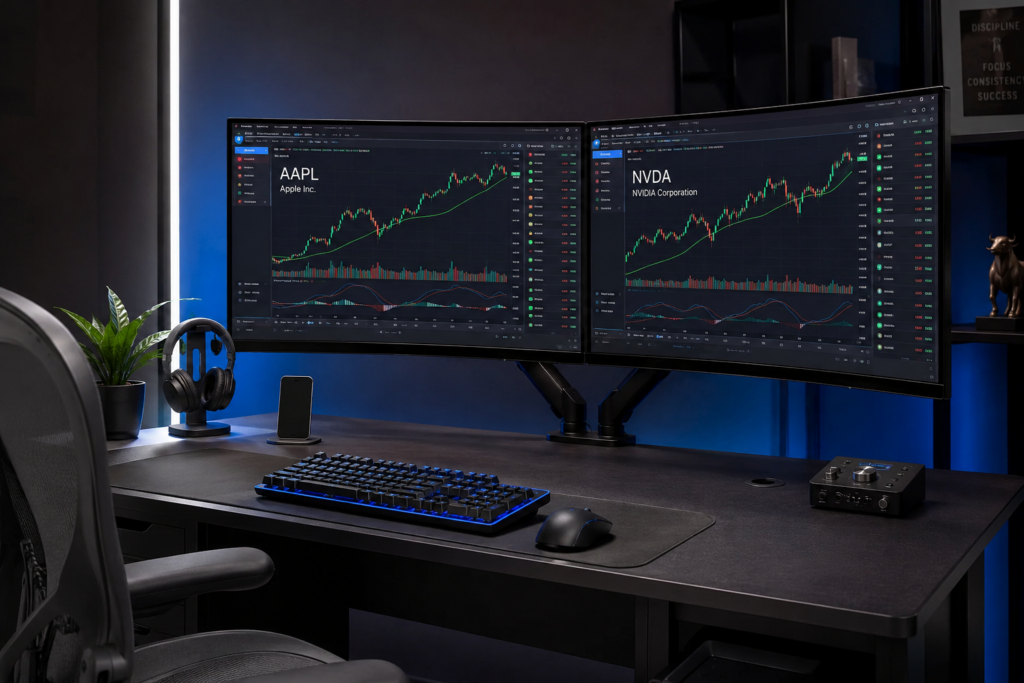
The Three-Question Filter to Find your Prop Firm
Before looking at profit targets, fees, or payouts, run three checks. In this order:
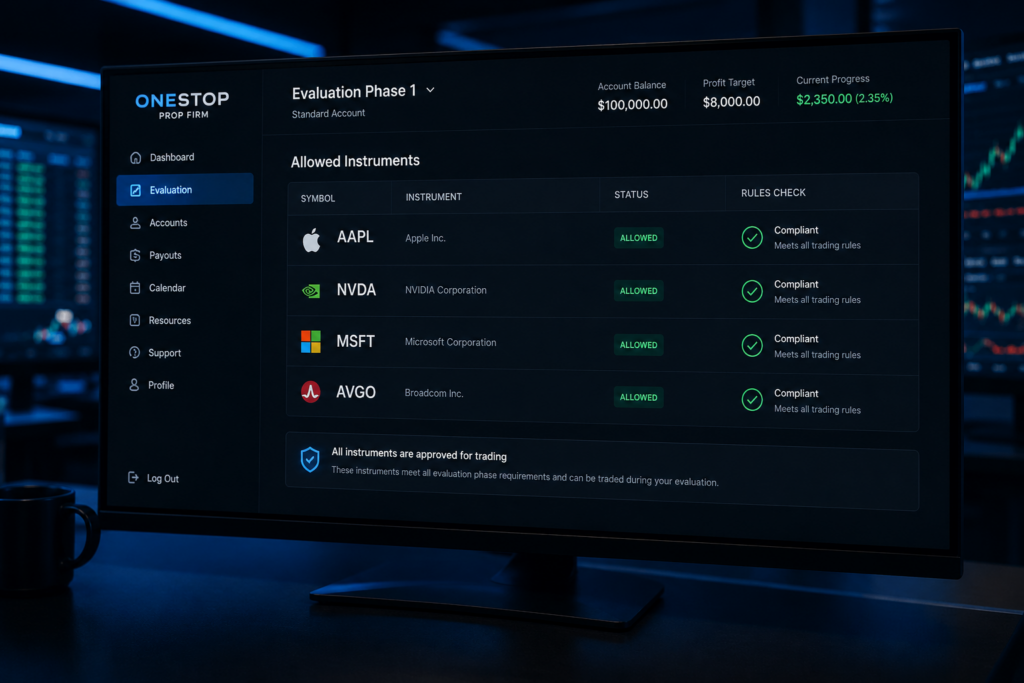
First: does this firm have the stocks you actually trade?
Not “stocks” as a category. Specific tickers. AAPL, NVDA, MSFT, AVGO, AMZN.
A lot of prop firms advertise stock access. When you open the instrument list, there are 8 symbols available.
That is not stock trading. That is a forex firm with a token equity section.
If you want a clear breakdown of which stocks hold up under prop firm rules, this guide to the best stocks to trade in a prop firm covers the specific names worth focusing on.
Second: how does the firm handle overnight gap risk?
Stocks gap between sessions. NVDA can open 8% lower the morning after a bad earnings report. AAPL has gapped on news with no warning.
If a firm counts that overnight move against your daily loss limit without any protection policy, that is a structural problem.
Forex pairs almost never move 5% overnight. Individual stocks do it regularly.
Understanding how the max daily loss rule interacts with gap events is critical before signing up. This breakdown of the max daily loss prop firm rule explains exactly how it plays out for stock traders.
Third: what are the minimum trading day requirements?
Some challenges require 10 days minimum. A few require 5.
If your style generates strong results in 3 focused sessions, a 10-day minimum means you are stuck manufacturing activity to hit a number.
Most liquid stock setups come in concentrated windows. You should not need to invent trades to satisfy an arbitrary day count.
Before evaluating any prop firm, it helps to have a clear picture of how prop firm rules actually apply to stock trading.
The One Stop Blueprint covers position sizing, daily loss management, and how to think about a funded account from day one. Free at onestopprop.com/newsletter.
The Short List After Applying the Filter
After running those three checks, the list of firms worth evaluating gets significantly shorter.
Here is what the landscape looks like for stock traders in 2026.
OneStopProp
The clearest case for stock traders specifically.
AAPL, NVDA, MSFT, and other major stocks are available inside the funded account. Not as a secondary option, but as a primary instrument class.
The one-step format means one evaluation phase, then funded.
OneStopProp also runs monthly competitions as a separate entry path. Different structure, same instruments and trading environment.
If you are deciding between a one-step challenge and a two-step structure, this comparison of 1-step vs 2-step prop firm challenges breaks down the mechanics directly.
For a stock trader who already knows their approach and wants a single focused evaluation on real equity instruments, this combination is direct.
FTMO
Strong track record. Long-established reputation in the prop space.
Primarily built around forex. Stock access exists, but the instrument depth is not the same as a stock-first environment.
For a trader focused on equities, it is worth pulling up the current instrument list before assuming stock coverage is comprehensive.
If you want a direct side-by-side, this breakdown of OneStopProp vs FTMO covers the key differences without the marketing noise.
Other Firms Worth Checking
There are other firms operating in 2026 that advertise stock access. Some newer entrants have more equity depth than their branding suggests.
The filter applies to all of them equally.
- Pull the instrument list. Verify the specific tickers you trade are there.
- Find the gap policy in writing. Not in a FAQ. In the actual challenge terms.
- Check the minimum trading day requirement before reading anything else about fees.
If a firm passes those three checks, it is worth a deeper look at profit targets, payout schedules, and fee structure.
Reversing that order wastes time on firms that will frustrate you before you ever get close to a funded account.
Conclusion
The top prop firm for a stock trader is the one that actually supports your instruments.
That sentence should be obvious. And it is not, because of how most prop firm lists are written.
Most rankings are built by forex-focused writers evaluating forex-built products. The stock trader angle is an afterthought.
Apply the three-question filter. Check:
- instruments
- the gap policy
- minimum trading days
After that, the fee and profit split comparison becomes meaningful.
Before that, you are just comparing marketing pages.
The One Stop Blueprint was built specifically for traders navigating funded accounts with a stock-first approach.
It covers account management, position sizing within drawdown limits, and how to think about scaling. Get it completely free at onestopprop.com/newsletter.
Entering a prop firm competition changes how you have to think about every single trade.
Not the rules. They stay exactly the same.
What changes is the objective.
In a challenge, the goal is to pass. In a prop firm competition, the goal is to beat everyone else on the leaderboard.
For stock traders, that creates a very specific set of decisions that most competition guides never actually address.
This one does.
What the Prop Firm Competition Format Actually Rewards
Before diving into strategy, it helps to understand how prop firm competitions work and how scoring is structured. The basics matter more than you might think.
Competitions reward percentage return relative to starting balance over the competition window.
Not absolute dollars. Percentage.
That means a trader on a $10,000 account competing against traders on $50,000 accounts is on equal footing if they produce the same return percentage.
It also means that compounding early gains is more valuable than protecting a mediocre position.
The format rewards aggressive consistency, not just caution.
Why Stock Traders Have a Natural Edge in a Prop Firm Competition
Forex pairs on a normal day move fractions of a percent.
A stock with a catalyst can move 5%, 8%, 12% in a single session.
That asymmetry matters enormously in a competition context.
A well-timed entry on NVDA during an AI news cycle, or AAPL on a product announcement, can generate in one session what a forex trader might chase for a week.
Stock traders also have access to sector rotation plays.
When semiconductors are running, the whole sector moves together.
A trader who reads that correctly and positions across a single strong name is not guessing. They are actually reading structure.
One clean high-conviction stock setup can do more for a competition leaderboard than ten cautious forex trades.
The 1st Week Trap That Kills Most Competition Accounts
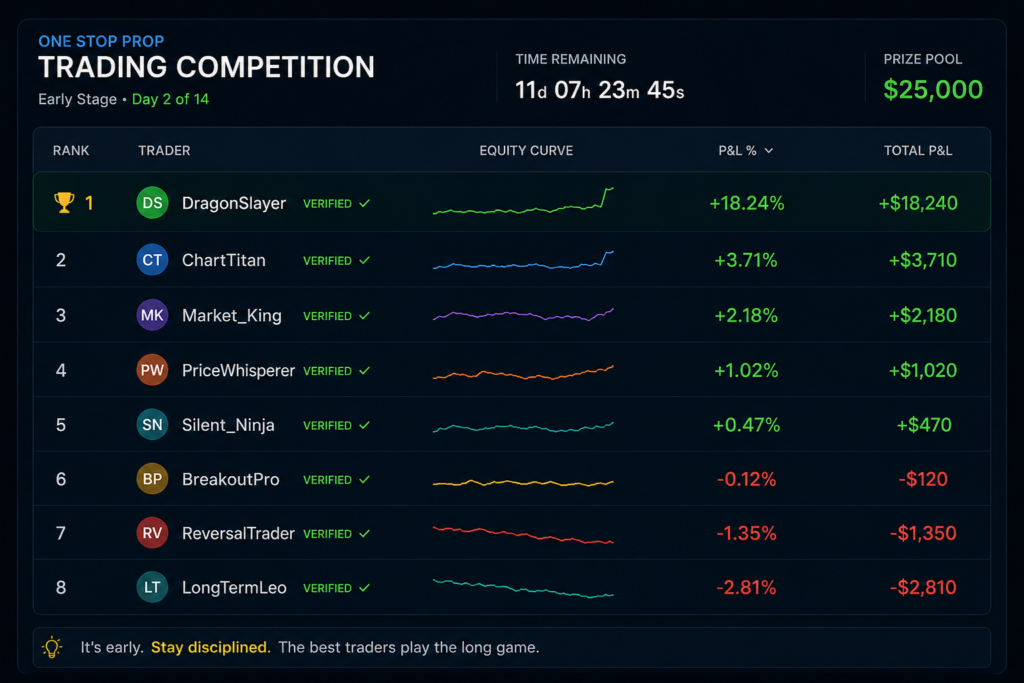
Day 3 of the competition.
Someone on the leaderboard is already up 18%.
You are up 3%.
The instinct is to catch up immediately.
But that instinct ends more competition accounts than any bad setup.
You do not know whether that 18% trader is up legitimately or one bad trade away from giving it all back.
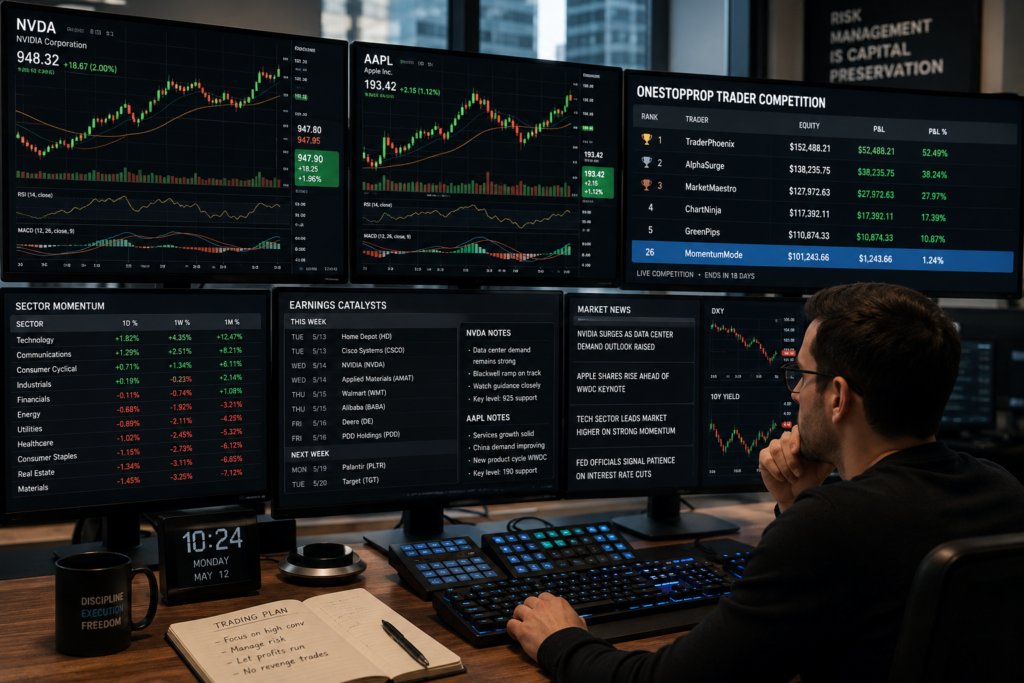
In the first week, the leaderboard is noise. Almost none of those early numbers survive to the end of the month.
The traders who win competitions over a full month are almost never the ones who led on day 3.
The approach that actually holds up in a prop firm competition is more boring than most traders expect.
Trade your normal game in week one.
Build a cushion. Don’t build a narrative.
How to Read the Leaderboard Without Letting It Read You
Week three is when the board starts to matter.
By then the noise is gone. The traders still near the top have survived long enough to be real.
Here is how to use that information without letting it distort your trading.
If you are in the top 3: protect it.
Do not take outsized risk to extend a lead you already have. The math favors the holder, not the chaser.
If you are in positions 4 through 10: stay consistent.
You are one solid week away from the podium. This is not the time for your biggest position of the month.
If you are outside the top 20 with a week left: now you can open it up.
At that point you are playing for a prize that requires a jump anyway. Calculated risk is appropriate.
The mistake is applying week-four logic in week one. The timing matters as much as the decision.
One more thing before we get into setups.
If you haven’t worked through how to structure your risk inside a funded account before entering a competition, the One Stop Blueprint covers exactly that.
Get the free Blueprint here and run through your own position sizing before you enter.
The Stock Setups That Actually Move the Needle in Competitions
Not every stock setup belongs in a competition.
Slow grinders do not work here. You need setups with room to run and clear catalysts behind them.
The ones that actually produce competition-changing returns:
Earnings breakouts in large-cap names. NVDA, AAPL, MSFT on strong beats. The move is real, it is fast, and the volume confirms it.
Sector momentum plays. When the AI trade or the semiconductor space is running, the whole group moves. Pick the strongest name and ride the wave, not the laggard.
Post-catalyst continuation. A stock that gaps up 8% on news and then consolidates for two days before continuing higher is giving you a second entry with defined risk.
These are not exotic strategies. The trading strategies that hold up inside prop firm challenges translate directly to competitions because the account rules are the same.
What changes in a competition is how aggressively you size those setups when they appear.
The One Rule That Never Changes, Even in a Competition
The daily loss limit applies in competitions exactly as it does in a challenge.
This is the part most traders forget.
They see a competition as a different context where normal risk rules are suspended.
They are not.
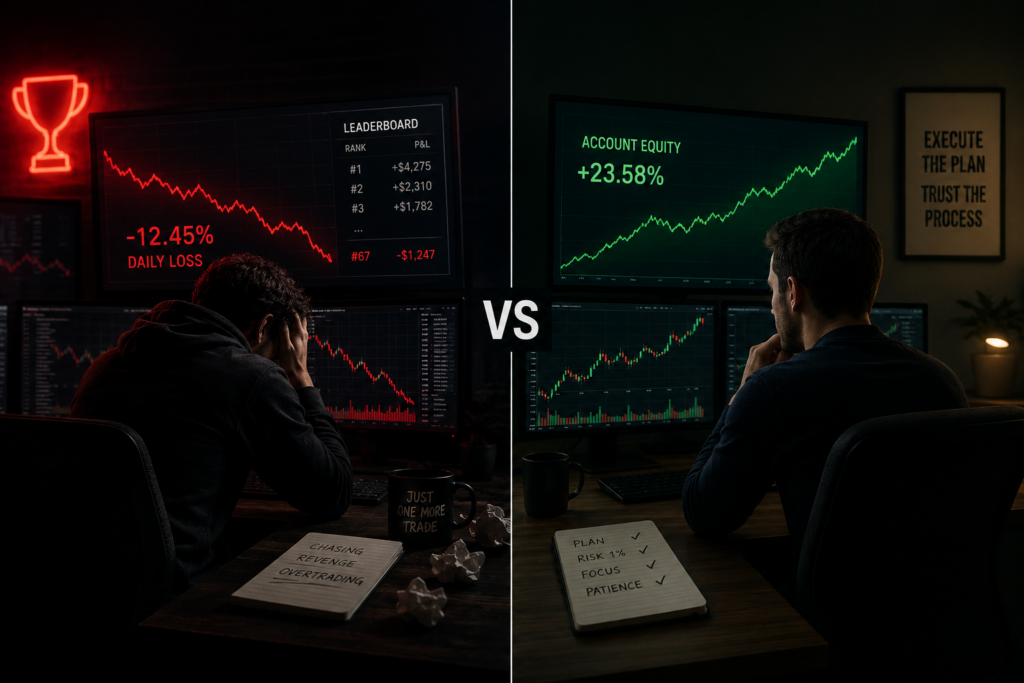
One of the fastest ways to exit a competition is also one of the most avoidable: the mistakes that end competition accounts almost always involve ignoring the daily limit in pursuit of the leaderboard.
The daily loss limit exists to stop a bad session from becoming a blown competition entry. Respect it.
A trader who hits the daily limit on day 12 is finished.
A trader who keeps that limit intact through a rough day comes back on day 13.
That is the edge. Survival, then acceleration.
Conclusion
Prop firm competitions are not a separate game.
They are the same game with a leaderboard and a time window.
Stock traders who understand that have a structural advantage, because stocks can deliver the kind of percentage moves that move leaderboards.
The traders who place are almost never the ones who traded hardest.
They are the ones who traded well for long enough.
Build a position. Read the leaderboard at the right time. Protect what you have when it matters.
OneStopProp runs monthly competitions with free entry and real prizes.
Enter the current competition at OneStopProp and bring your stock trading edge to a competition that was built for it.
Most beginners don’t fail because they picked a bad prop firm.
They fail because they picked the wrong challenge inside a decent firm.
That distinction matters more than people think.
I’ve seen it happen in a very predictable way.
Someone gets excited, buys a $100K challenge, feels like they just leveled up…
And then, they blow it in two days.
Not because they’re dumb.
But because the setup didn’t match how they trade.
So before you look at “best prop firms”, you need to understand something simpler:
👉 What kind of challenge can you actually survive?
What Beginners Get Wrong About Challenges
They chase size.
Bigger account = bigger profit.
Makes sense in your head. Feels like progress.
But inside a challenge, bigger size usually means:
- tighter emotional pressure
- faster drawdown violations
- worse decision-making
That $100K account doesn’t feel like an opportunity anymore.
It feels like a clock ticking.
The First Real Rule (Nobody Follows It)
Pick a challenge you can trade calmly.
That’s it.
If your heart rate goes up every time you open a trade, you already lost.
Most beginners need less size, not more.
Something that lets them:
- think clearly
- take losses without spiraling
- stay inside rules without forcing trades
That’s where consistency starts.
What Actually Makes a Good Beginner Challenge
People expect a checklist here.
You don’t need one.
You need to understand pressure.
A good beginner challenge feels manageable on a random Tuesday afternoon when nothing is happening.
Not exciting. Not stressful. Just… tradable.
That usually means:
- reasonable drawdown relative to your risk
- profit target you don’t feel forced to chase
- rules you can actually remember without checking every five minutes
If you need to reread the rules mid-trade, that’s already friction.
Where Most Firms Trick You (Without Lying)
This part is subtle.
They don’t lie, but they frame things.
You’ll see:
- high payout percentages
- “easy” challenge models
- mega discounts everywhere
And your brain goes:
“this looks like a good deal”
But challenges are not products.
They’re environments.
And some environments are built to:
- get you in fast
- keep you repeating
Others are built to let you stabilize.
That difference doesn’t show up on the pricing page.
A Better Way to Choose
Instead of asking:
“which challenge is easiest to pass”
Ask yourself: where am I most likely to stay consistent?
That question changes everything for you in practice.
Because passing once is random.
Staying within rules over time isn’t.
Where OneStopProp Fits In
If you’ve read the other articles, you already know where this is going.
The angle here isn’t “easiest challenge”.
It’s what happens after you pass.
From the brain:
- focus on scaling
- no hidden rules blocking payouts
- environment built around consistency
That matters more than people think.
Because beginners don’t just “need to pass”.
They need to not fall apart right after that.
There’s also the competition angle.
You can actually test the environment without putting money in.
Most people skip that and go straight to buying.
That’s a mistake.
A Small Detail That Changes Everything
I remember the first time I tried a challenge seriously.
I had the rules open on a second monitor.
Not because I wanted to. Because I didn’t trust myself not to break something.
That’s the feeling you want to avoid.
If the challenge makes you second-guess every move, it’s too tight for your level.
If you don’t want to learn this the expensive way:
It breaks down:
- how to approach challenges
- how to manage risk
- how to stop blowing accounts
The Truth Most People Ignore
There is no “best beginner challenge”.
There’s only the one you can execute on without breaking yourself
And most people choose based on ego.
They want the bigger account.
The faster pass.
The bigger payout.
And then they fail and blame the firm.
Final Conclusion
If you’re just starting:
- go smaller than you think you should
- trade slower than you want to
- and focus on not breaking rules
That alone puts you ahead of most people.
And if you’re trying to choose between actual firms:
👉 Read this next: OneStopProp vs FTMO
Your first challenge shouldn’t prove you’re a great trader.
It should prove you can survive. Good luck.
Most traders don’t fail prop firm challenges because they can’t trade.
They fail because they approach it like a normal trading account.
And it’s not.
A prop firm challenge is a rules-based environment.
If you don’t adapt to it, you will lose your account — even if your strategy works.
That’s why you see the same pattern over and over again:
- Good traders blowing accounts
- Profitable traders failing challenges
- Beginners repeating the same mistakes
So if you’re about to take a challenge (or already failed one), this is what you actually need to understand.
Why Most Traders Blow Their Accounts
Before we talk about how to pass…
You need to understand why people fail.
Because if you don’t fix this, nothing else matters.
The real reasons:
- Risking too much per trade
- Overtrading to hit profit targets faster
- Ignoring daily loss limits
- Not fully understanding the rules
- Letting emotions take over after a loss
Notice something?
👉 None of these are strategy problems.
They’re behavior problems.
The Biggest Mistake: Treating It Like a Normal Account
This is where most traders mess up.
In a personal account, you can:
- Hold through drawdowns
- Adjust risk on the fly
- Take aggressive setups
In a prop firm challenge?
👉 That mindset gets you disqualified.
Because you’re trading inside constraints.
And those constraints are what define the game.
The Only Way to Pass: Think Like a Risk Manager
If you want to pass a challenge, stop thinking like a trader.
Start thinking like a risk manager.
Your goal is NOT:
- maximize profit
- catch big moves
- trade every opportunity
Your goal is to stay within the rules while slowly building consistency
That’s it.
The Core Rules You Must Respect (No Exceptions)
Every prop firm is slightly different.
But most follow similar structures:
- Daily loss limit (usually ~5%)
- Maximum drawdown (~10%)
- Profit target (~8-10%)
- Minimum trading days
And here’s the key:
👉 You don’t beat these rules. You work within them.
The Risk Management Framework That Actually Works
This is where most traders need structure.
Here’s a simple framework that dramatically increases your chances:
1. Risk 0.5%-1% per trade
Anything above that is aggressive in a challenge environment.
2. Max 2-3 trades per day
More trades ≠ more profit
More trades = more chances to break rules
3. Stop trading after 2 losses
This alone saves accounts.
4. Aim for consistency, not speed
You don’t need to pass in 3 days.
You need to pass without blowing the account.
If you want a structured version of this…
It breaks down:
- exact risk rules
- challenge strategy
- how to avoid common mistakes
Why Traders Fail Even With a Good Strategy
Let’s be honest.
Most traders already have some kind of strategy.
But that’s not the issue.
The issue is the execution under pressure.
Once real rules are involved, everything changes because:
- you rush trades
- you force setups
- you revenge trade
And suddenly… the account is gone.
The Psychology You Need to Win
Passing a challenge is more mental than technical.
You need:
- patience
- discipline
- acceptance of slow progress
Because if you try to rush it… then you will fail.
Choosing the Right Prop Firm Matters More Than You Think
This is something most people realize too late.
Even with good risk management…
Some prop firms make it harder than it should be.
Not because they’re scams.
But because their structure is not built for real trading behavior.
What you want is a firm that:
- has realistic rules
- doesn’t punish normal trading activity
- allows you to stay consistent
Because again. Passing once is easy compared to staying funded.
If you’re looking for a prop firm that actually aligns with this approach:
👉 Start your funded account with OneStopProp today.
Conclusion
Passing a prop firm challenge is not about being the best trader.
It’s about being the most disciplined one.
If you:
- manage risk properly
- respect the rules
- stay consistent
You will pass. But if you:
- chase profits
- overtrade
- ignore structure
You simply won’t. It’s that simple.
And if you want to shortcut the learning curve:
Because the difference between failing and getting funded…
Is usually just structure.
Understanding Funded Trading: Your Path to Financial Freedom
Funded trading is transforming the financial landscape by providing an incredible opportunity for skilled traders to access capital without risking their own money. This approach allows the funded traders to prove their abilities and get financed by proprietary trading firms and also known as prop firms. If you have ever struggled with limited capital in trading, funding trade might be your perfect solution. Traders now have a chance to trade in the financial markets, earn profits and scale their trading careers without bearing heavy financial risks.
Understanding Of Funded Trading
It is a process where traders receive capital from proprietary trading firms after proving their funding trading skills through an evaluation. Now traders can trade funding with the firm’s money and share the profits. This type of trading is appealing because it removes the lack of capital problem. Many talented traders struggle to grow their accounts but funded trading provides an easy way to do professional trading without requiring an initial investment.
How Does Trading With Funded Capital Work?
This trading is structured around a multi-step process to assess a trader’s skill level, risk management abilities and profitability. Here’s how it typically works:
1. Evaluation Phase
Traders must pass a challenge before granting access to their capital-funded trading firms. This funding process ensures traders have a solid strategy and can manage risk effectively. The evaluation phase generally includes:
- A simulated trading account with virtual funds.
- A specific profit target to achieve within a set time.
- Risk management rules, such as maximum drawdown limits.
- Restrictions on trading behavior (e.g., no excessive risk-taking).
Traders who meet these requirements progress to the next phase.
2. Verification Stage
Some firms include a verification phase after the initial evaluation to confirm consistency in a trader’s performance. This step ensures that the trader is not relying on luck but possesses a well-structured strategy.
3. Funded Account Access
Once traders complete the evaluation, they will receive access to a funded trader account. It means they can now trade real capital provided by the firm. The size of the funded account varies depending on the firm and the trader’s performance.
4. Profit Sharing
The key benefit of capital raise trading is that traders can keep some profits. Most firms offer a profit split from 50% to 90% depending on the program’s structure. This trading firm with funded capital means traders can generate significant income while the firm takes a share in exchange for providing the capital.
Benefits Of Trading With Funded Capital
Trader funding offers advantages that make it an attractive option for traders worldwide. Some of the key benefits include:
1. Access to Substantial Capital
One of the biggest barriers to successful trading is limited capital. This capital raise eliminates this issue by giving traders access to larger trading accounts. It enables them to take advantage of more significant market opportunities without personal financial risk.
2. Reduced Financial Risk
Since traders use the firm’s capital, they are not putting their money on the line. It reduces financial pressure and lets traders focus purely on their strategy.
3. Professional Trading Environment
Many funded programs offer traders advanced trading tools, market insights and mentoring. These enhance their skills and prepare them for professional trading environments.
4. Scalable Earnings Potential
The profits of traditional trading depend on personal investment and trading with funded capital allows traders to scale their income. Traders can receive larger funded accounts by proving their consistency and increasing their profit potential.
5. No Need for Personal Investment
Funded firms cover all trading capital so traders do not have to invest their money. It makes it an attractive option for those who want to trade professionally but lack the financial resources.
Challenges of Trading With Funded Capital
Funded firms offer many benefits but these are not without challenges. Some key difficulties traders may face include:
1. Strict Trading Rules
These trading firms impose strict rules regarding risk management, daily drawdowns and profit targets. Traders must follow these guidelines to avoid disqualification.
2. Evaluation Fees
Most trading programs require traders to pay an evaluation fee to participate in the challenge. This fee is relatively minimal compared to the funding potential but requires an upfront investment.
3. Psychological Pressure
Trading with someone else’s money can create additional psychological pressure. Traders must be disciplined and stick to their strategy to succeed in funded programs.
4. Profit Splits
Traders keep 100% of their profits in self-funded trading but trading with capital funds involves a revenue split with the firm. It is a fair deal for the capital provided which means traders earn only a portion of their profits.
Best Firms For Trading With Funded Capital
Several reputable firms offer funded capital trading programs. Each firm has different requirements and financing structures, so traders should carefully evaluate which best suits their trading style. Some of the most well-known ones include:
- One Stop Prop – A proprietary trading firm provides traders with capital to trade Forex, stocks and cryptocurrencies.
- FTMO – One of the most popular funded firms for trading that offers significant capital and high-profit splits.
- TopStep – Focuses on futures trading and provides traders with excellent learning resources.
- My Forex Funds – A great option for forex traders looking for flexible evaluation models.
- The Funded Trader – Provides multiple evaluation paths and competitive profit splits.
- Certified Funded Trader – The certified funded trader offers rigorous evaluations and advanced risk management guidelines.
Is Trading With Funded Capital Right for You?
It might be better to refine your skills before attempting a funded challenge. This process is an excellent option for traders who:
- Have a proven trading strategy but lack capital
- Are disciplined and can follow strict risk management rules
- Want to trade professionally without personal financial risk
- Are willing to go through an evaluation process to prove their skills
Final Thoughts
Trading with funded capital allows traders to trade with certified funded trader accounts without personal financial risk. Traders can access substantial capital, scale their earnings and build a successful trading career. If you are confident in your trading abilities and ready to take the next step, exploring funding trading and trader funding programs could be your ticket to financial freedom. However, choosing the right firm, understanding the rules and trading disciplinedly are essential to maximize success.
FAQs
1. How long does it take to get funded?
The time frame varies by firm and trader performance. Some traders complete evaluations in a few weeks, while others may take months.
2. Do I need prior trading experience to apply?
Yes, most funded trading programs require traders to demonstrate experience, risk management skills and consistency before getting funded.
3. Can I withdraw my profits anytime?
Some firms allow bi-weekly or monthly withdrawals, while others have specific profit thresholds before withdrawals are permitted.
4. What happens if I break the risk rules?
If a trader violates risk management rules, they may lose their funded account and must restart the evaluation process.
5. Is funded trading suitable for beginners?
Funded trading is best suited for experienced traders. Beginners should practice using demo accounts and develop their strategies before applying them.